admin
admin According to the latest data released by the World Gold Council, global central banks reversed massive net gold sales of nearly 30 tonnes in March and posted 17 tonnes of net gold purchases in April 2026. Sovereign funds returned to gold buying, yet monthly purchase volume fell short of last year’s level. Supported by stronger US dollar and Treasury yields plus continuous ETF outflows, international gold price faces obvious upward pressure. Central banks took divergent moves on gold reserve allocation, with most Eastern European and Asian nations accumulating gold while a few economies including Russia kept offloading reserves.
Poland remained the world’s top gold purchaser in April with 14 tonnes of net purchase, accounting for over 80% of global official monthly net buying. Its total gold reserve hit 595 tonnes, making gold 30% of Poland’s official foreign reserves; cumulative purchases from January to April reached 45 tonnes, continuing its two-year record as the largest annual gold-buying central bank globally. The People’s Bank of China accelerated its purchase pace by adding around 8.09 tonnes in April and lifting total reserves to 2322 tonnes, marking its 18th consecutive month of gold accumulation and the second-largest monthly purchase since December 2024. Czech National Bank kept steady small-scale purchase of 2 tonnes in April, bringing its gold reserve to 79 tonnes or 6% of total national reserves after 38 straight months of regular buying.
On the selling side, national policies varied sharply. Türkiye, a major gold seller in March, kept flat gold reserves in April after settling mature short-term gold-dollar swap contracts and only keeping long-dated swaps outstanding. Russia’s central bank cut gold holdings for four successive months with 6 tonnes sold in April and 22 tonnes of year-to-date sales. Uzbekistan offloaded 1 tonne in April but stayed a net buyer in 2026 with 24 tonnes of cumulative purchases, second only to Poland; gold makes up 88% of its foreign reserves.
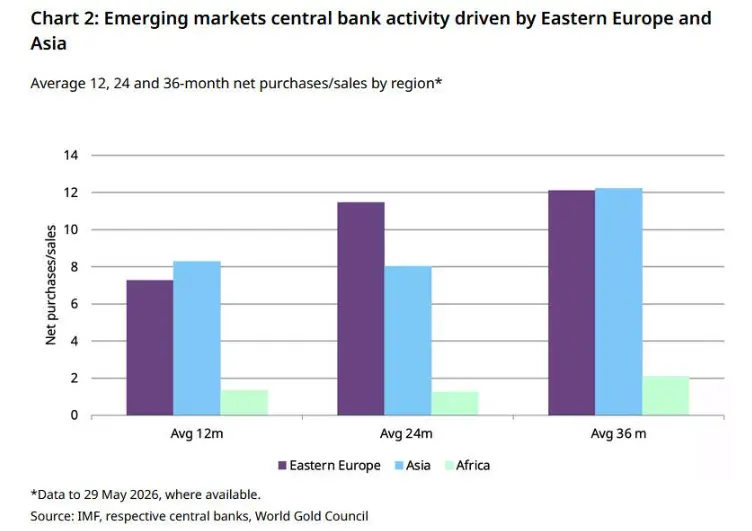
Over the past 36 months, central banks from Eastern Europe and Asia have dominated global gold demand with average monthly net purchases of 12 tonnes and 11 tonnes respectively. However, Goldman Sachs pointed out current official buying momentum is much weaker than last year. Gold ETFs which once pushed gold above USD 5,000 per ounce keep shrinking holdings, and speculative capital has shifted massively into memory chip and tech stocks.
Besides, better-than-expected US economic strength drives higher US Treasury yields and US dollar, weighing on short-term gold price. In the long run, central banks retain strong willingness to hold gold for risks hedging, and upcoming WGC survey proves most institutions stay bullish on gold’s reserve value, sustaining the long-term official gold accumulation trend.