admin
admin On May 26 local time, NASA held a press conference at its Washington headquarters to release the full blueprint for a permanent lunar base. Three pre-development unmanned missions are scheduled in 2026 to pave the way for Artemis crewed lunar landing in 2028, with the lunar South Pole selected as core construction site via commercial aerospace outsourcing and phased development strategy.
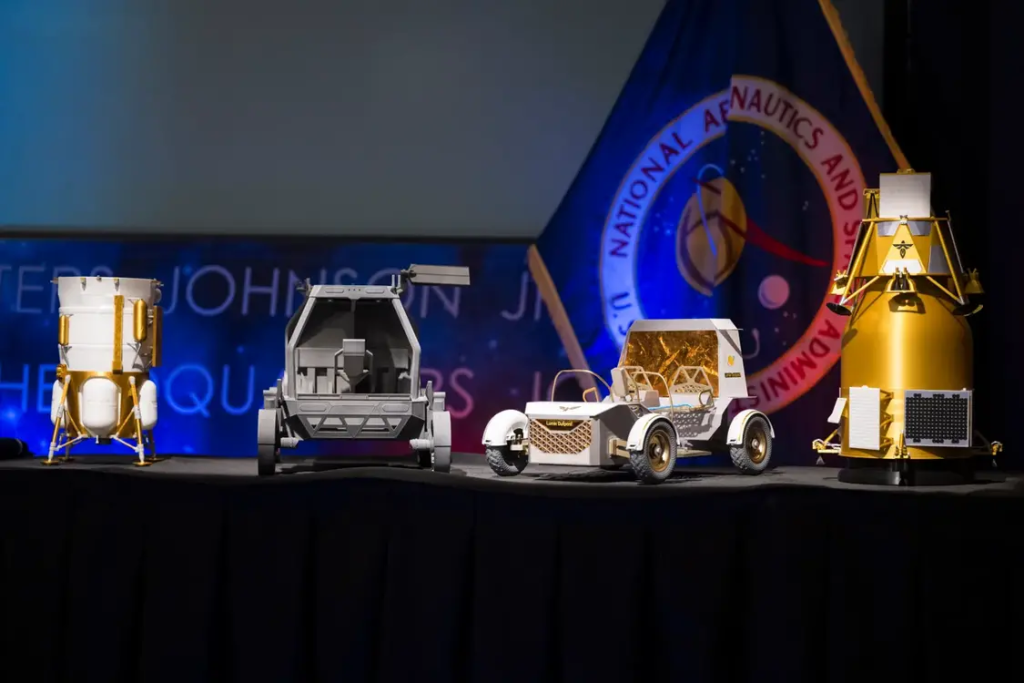
All three initial base missions will launch within 2026. Mission 1 will lift off no earlier than autumn 2026 with Blue Origin’s Blue Moon Mark 1 Endurance lander, touching down at Shackleton Connecting Ridge of lunar South Pole. It carries stereo cameras for lunar dust research and laser retroreflector arrays to study thruster-lunar soil interaction and build lunar laser positioning benchmarks. Mission 2 employs Astrobotic’s Griffin lander to deliver over 500kg cargo including Astrolab’s FLIP rover, testing mobility systems for future crewed lunar terrain vehicles. Mission 3 relies on Intuitive Machines’ Nova-C Trinity lander to explore lunar swirls, with collaborative payloads from ESA and South Korea’s astronomy institute for extreme lunar environment research.
NASA’s three-phase construction roadmap covers distinct targets: Phase 1 (2026–2029) centers on robotic exploration with 25 planned launches and 21 lunar landings, transporting 4,000kg payload for site survey and equipment verification; Phase 2 (2029–2032) focuses on constructing power, communication and preliminary habitation infrastructure; Phase 3 from 2032 onwards realizes semi-permanent astronaut residence and regular lunar scientific missions.
For hardware procurement, NASA signed major contracts with multiple private space firms: USD 219 million for Astrolab and USD 220 million for Lunar Outpost to develop crewed lunar vehicles supporting manual and autonomous driving. Blue Origin secured a base contract worth USD 188 million plus optional extra orders up to USD 280.4 million. Firefly Aerospace is tasked to build spacecraft carrying four lunar drones set for 2028 launch to map remote South Pole terrain. Besides, NASA released the CLPS Phase 2 solicitation on May 15 to keep opening cooperation slots for private space industry, cutting lunar exploration cost via marketization to accelerate base construction.
NASA Administrator Jared Isaacman stated the lunar outpost will be humanity’s first permanent foothold off Earth. All crewed and robotic missions will gather operational experience under extreme space conditions, driving technological innovations benefiting Earth and laying solid groundwork for future crewed Mars exploration.