admin
admin At Microsoft Build 2026 Developer Conference held in San Francisco, Microsoft unveiled its self-developed full lineup of MAI AI models led by core coding and reasoning variants, alongside Project Solara new-concept hardware and AI assistant Scout. This comprehensive launch marks Microsoft’s core strategy for the upcoming agent era and helps the tech giant cut reliance on third-party AI models from OpenAI and Anthropic, evolving from a pure cloud vendor into a full-stack AI platform provider.
Microsoft has poured billions into AI investment, including USD 13 billion in OpenAI and USD 5 billion in Anthropic, distributing their AI services via Azure cloud platform for years. Yet surging licensing fees for third-party models plus the ongoing IPO preparations of OpenAI and Anthropic pushed Microsoft to develop in-house foundational models to reduce external costs and retain core industrial profits. Google’s release of Gemini 3.5 Flash coding model last May further accelerated Microsoft’s self-developed AI roadmap.
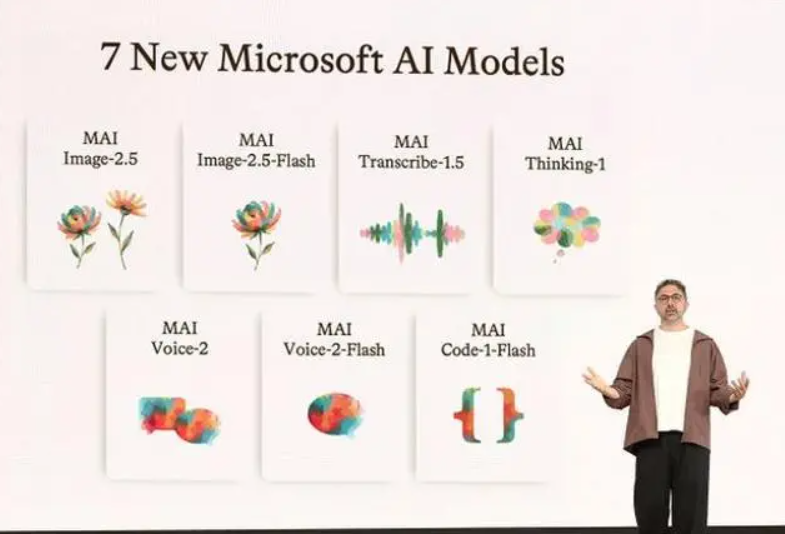
MAI-Code-1-Flash, Microsoft’s debut native code-generation model, can generate full source code for apps and websites from natural language prompts, and has been fully integrated into GitHub Copilot and VS Code for both professional developers and coding beginners. The flagship reasoning model MAI-Thinking-1, trained entirely on proprietary licensed data without any third-party model distillation, opens private preview on Microsoft Foundry, allowing enterprises to import private datasets for customized fine-tuning. Mustafa Suleyman, Microsoft’s AI chief, confirmed that MAI models optimized for McKinsey outperform OpenAI’s GPT-5.5 with a whopping 90% cut in comprehensive operating costs. Apart from the two flagship products, the complete MAI portfolio includes image generation, voice synthesis and multi-language transcription lightweight models, with selected variants deployable locally on Windows devices to build up end-cloud hybrid model ecosystem.
On the hardware front, Microsoft unveiled Project Solara with two prototype devices powered by MediaTek and Qualcomm chips respectively. Free from conventional mobile OS and standalone apps, the gadgets run entirely on embedded AI agents connected to cloud computing resources. In medical scenarios, they automatically archive consultation records and generate clinical documents, paving a new path for post-App intelligent hardware development.
For application upgrades, newly-launched AI agent Scout works persistently in the background, sorting emails and team chats automatically and flagging critical pending items to streamline corporate and individual workflow efficiency. Satya Nadella pointed out during the keynote that the industry paradigm has shifted drastically: enterprises shift from mere AI consumers to core contributors of the whole AI ecosystem. By combining self-developed AI models, innovative hardware terminals and agent-native software, Microsoft aims to secure a dominant foothold amid the global agent-driven AI transformation.
 微信扫一扫打赏
 支付宝扫一扫打赏