admin
admin At Microsoft Build 2026 Developer Conference, Microsoft breaks away from its long-term reliance on OpenAI and completes end-to-end AI layout with five core product lines: seven self-developed MAI large models, RTX Spark mini workstation, brand-new Agent hardware terminals, OpenClaw security framework and upgraded Majorana 2 quantum chip. Its core goal is to upgrade regular personal computers into AI agent workstations capable of running tasks around the clock, transforming itself from a pure cloud service provider into a leading full-stack AI platform giant.
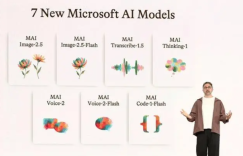
Microsoft once secured early AI dividends via deep partnership with OpenAI’s large language models, yet to gain full industrial initiative, it rolled out seven in-house MAI models spanning reasoning, coding, image generation, speech synthesis and audio transcription, all trained from scratch with legally licensed raw data and zero third-party model distillation. The flagship reasoning model MAI Thinking-1 adopts sparse MoE architecture with 35 billion active parameters and nearly one trillion total parameters, supporting a 256K-token context window equivalent to roughly 600 pages of documents; it is available for private preview on Azure AI Foundry. MAI Code-1-Flash is natively optimized for GitHub Copilot, scoring 51.2% on SWE Bench Pro and outperforming Claude Haiku 4.5 by a wide margin, enabling agentic programming inside VS Code. Meanwhile, MAI’s image, voice and transcription variants are deeply integrated with Microsoft Office suite, Teams and Dynamics365; MAI Transcribe-1.5 supports 43 languages with fivefold faster processing speed than competing alternatives. All MAI models are tuned for Microsoft’s proprietary Maia200 silicon, delivering a 1.4x uplift in per-watt efficiency during on-premise deployment. The newly launched Frontier Tuning tool empowers enterprises to import internal workflow data for customized industry-specific AI training.
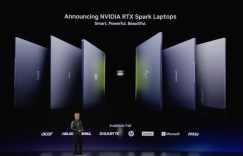
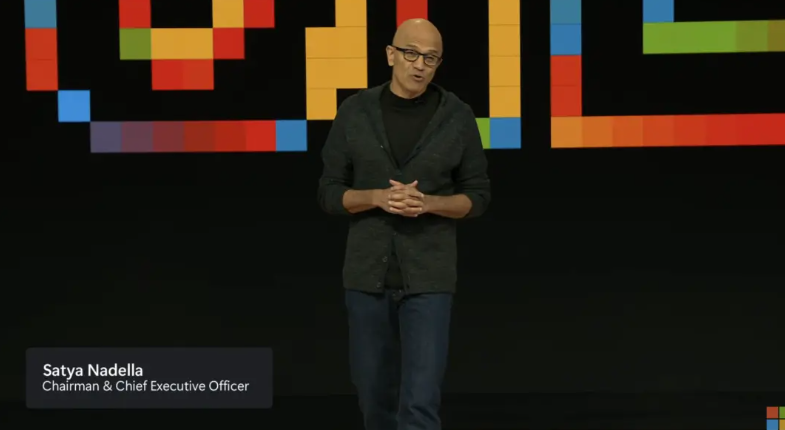
On hardware front, Surface RTX Spark Dev Box, dubbed “dream machine” by Satya Nadella, serves as the cornerstone of on-device AI deployment. Powered by NVIDIA RTX Spark SoC, the mini workstation features a 20-core CPU plus 128GB unified memory and delivers 1 PFLOPS FP4 AI computing power. Its all-aluminum unibody chassis doubles as cooling component with a 100W TDP rating. Preloaded with developer-tailored Windows 11 Pro, the device comes with preinstalled VS Code, WSL2, GitHub Copilot and full dev toolchains; bloatware notifications are disabled by default with dark and developer mode enabled, set to hit official US shelves this fall. With this device, developers can fine-tune LLMs and deploy local AI agents offline, turning PCs from manually operated tools into autonomous local AI workstations.
Microsoft also unveiled two form-factor devices under Project Solara: a desktop terminal powered by MediaTek chips unlocks personalized Agent workspace via facial recognition and links Microsoft 365 Copilot with Cloud PC; a Qualcomm-powered wearable ID badge supports on-site shooting and voice note recording for healthcare and field service, exploring the next-gen decentralized smart hardware paradigm. For enterprise Agent security, Microsoft co-launches exclusive Windows toolkit with OpenClaw team led by Peter Steinberger to realize granular permission control over file access, clipboard and network connectivity. Live demo proves restricted read-only folders can block unauthorized file deletion even when partial security layers are temporarily disabled.
In application and compliance segments, Microsoft will revamp Copilot this summer by unifying chat, teamwork and coding modules alongside Scout, the first commercial Autopilot Agent. Agent365 connects Entra, Defender and Purview to centrally manage cross-cloud AI agents, while Web IQ fetches real-time online information to ensure accurate and up-to-date Agent outputs. The conference closes with Majorana 2 topological quantum chip, whose qubit average lifespan hits 20 seconds (max nearly one minute), marking a 1000x stability boost versus the prior generation and speeding up Microsoft’s timeline for practical quantum computing commercialization.
From leveraging OpenAI for early AI access to building a complete Agent ecosystem via self-developed software and hardware, Microsoft is securing core platform access of global AI industry and ushering in a Windows-powered PC Agent era.
 微信扫一扫打赏
 支付宝扫一扫打赏