admin
admin At the end of May 2026, Spark Space officially announced the development of Jinhua-1 (JH-1), China’s first electric-cycle liquid-fuel launch vehicle, which also ranks as the world’s most powerful in-development electric-cycle liquid rocket, marking a landmark technical breakthrough for China’s commercial aerospace industry in liquid rocket propulsion systems.
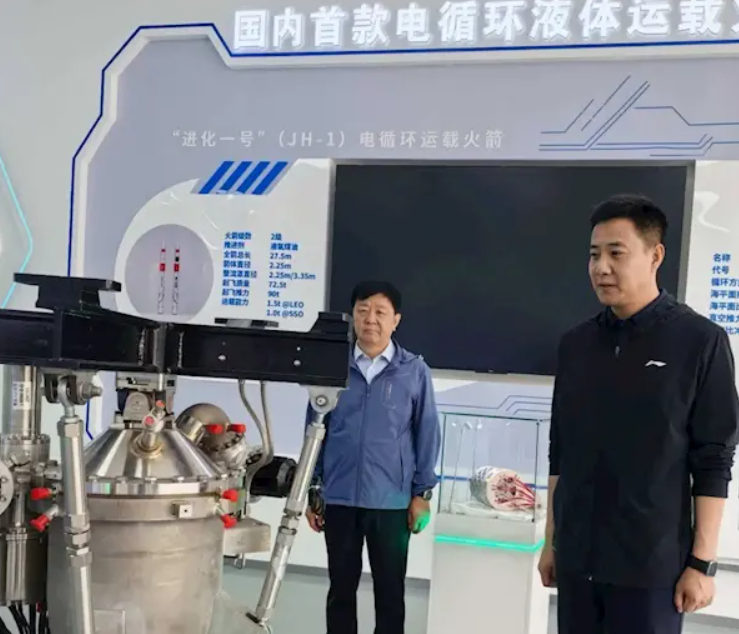
On May 30, officials from Jiuquan visited Spark Space’s headquarters in Hefei to negotiate deep cooperation on dedicated launch pad construction and industrial implementation, accelerating pre-launch preparation for JH-1’s production and liftoff schedule. Founded in May 2024 in Hefei with a core team from Beihang University, Spark Space is China’s exclusive enterprise focusing on the full industrial chain of electric-cycle liquid rockets. Its Hefei manufacturing base broke ground on December 10, 2025, when JH-1 was officially unveiled, with its maiden flight scheduled for 2027.
In specifications, JH-1 measures 27.5 meters in total length and 2.25 meters in body diameter, with a liftoff thrust of 90 tons. It can deliver a payload of 1.5 tons to Low Earth Orbit (LEO) and 1 ton to Sun-Synchronous Orbit (SSO), catering to single small-satellite deployment, mini-constellation construction and large constellation replenishment, earning it the moniker of “affordable space express” in the industry. The rocket adopts a 9+1 engine layout: nine sea-level variant Flame No.2 (LY-2) engines clustered for the first stage plus one vacuum-type LY-2 for the upper stage. The self-developed 10-ton-class LY-2 electric-cycle engine finished its full-system hot-fire test successfully on March 10, 2026, fully verifying the practicability of the electric pump cycle route.
The core innovation of JH-1 lies in its electric-cycle propulsion, vastly different from conventional liquid rocket cycles like gas-generator and staged combustion. Traditional engines use high-temperature gas to spin turbopumps for propellant feeding, leading to complicated structures, high manufacturing costs and frequent potential faults. Instead, the electric-cycle design uses battery-powered electric pumps to feed propellants, eliminating cumbersome components such as gas generators and turbines. This design simplifies engine layout, cuts production costs and failure risks, and enables precise thrust adjustment and multiple restarts via electronic control, shortening launch preparation cycles and enabling frequent, mass-produced commercial space launches.
With strengths in low cost and high reliability, JH-1 targets the booming small-satellite launch market. Its disruptive propulsion technology promotes the industrialized development of China’s commercial aerospace and fills the equipment gap for low-cost, rapid space launches nationwide.
 微信扫一扫打赏
 支付宝扫一扫打赏